

OceanMore, 2016, 400 pages
Sample English and French translation available
Translation rights sold: Hungary (Metropolis Media), Norway (Cappelen Damm), Slovenia (Beletrina), Serbia (Književna radionica Rašić), Bulgaria (Paradox)
Option publisher: Amazon Crossing (WEL)
Film/TV rights sold to Antitalent
T-portal Best Novel Award
Ksaver Šandor Gjalski Award
Fran Galović Award
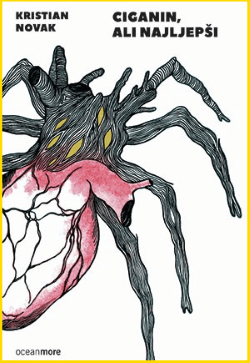
Gypsy, But the Fairest of Them All by Kristian Novak is strictly speaking a crime novel, with a central enigma of brutal murders of several Johns Doe – because victims without faces are hard to identify – and an overarching investigation. But don’t be too quick to label it, because this is a thriller as much as Crime and Punishment.
Gypsy is narrated by four narrators, in truncated transcripts: Milena, the middle-aged returnee to her birthplace; Nuzat, a Kurd from Mosul on his way to Calais; Sandokan nicknamed Sandy – a gypsy from North Croatia, and Plančić – the PR manager for the Zagreb Police Station.
The novel has a wide scope, entangling several lives between the rivers Drava and Mura in the northernmost part of Croatia, and the subject matter it raises is bound to receive more and more attention over the years. It charts two biographies from cradle to grave, it encompasses and reconstructs at least three cultural circles, it creates explosive psychoportraits of the four storytellers and mass psychology of a crowd that threatens to end things violently.
This is a book where you’ll find al-Anfal, Daesh (ISIS) and the refugee wave, forbidden love between a Croatian woman and a gypsy man, a Croatian Homeland War veteran securing peace in his village, a policeman having schizoid episodes in the dusk of his career, an orgy with Moldavians in a weekend house, theory and practice of theft and fist-fight, a spider weaving a web, Internet rage, splendour of language, thought and emotion.
In late 2017, the book was successfully adapted for the stage at the Croatian National Theater. In less than a year, an audience of a total 18.000 people has seen the play, and it has been one of the most popular Croatian plays in the last decade.